
Ewing Township Previous Residents by Era
The backward trail for an Ewing Township address changes with the date. Mercer County deeds can establish recorded ownership, while local directories and telephone books supply occupant or subscriber leads. Census schedules add household detail at their enumeration date. Maps explain an altered number or lot. The table separates those roles so a property transfer is not mistaken for proof of who lived at the address.
| Source | Years it covers | Where held | What it shows |
|---|---|---|---|
| Mercer online deed index | Approximately 1997-present online | Mercer County Official Records | Recorded instrument metadata, with image and fee rules varying by record |
| Mercer deed books and older indexes | County holdings from 1838; earlier than the online interval needs office research | Records Room, Old Court House Annex | Grantor, grantee, legal description, and older title trail |
| Trenton and regional directories | 1845-1971, with suburban and Mercer County runs for later periods | Trentoniana and Trenton Historical Society | Address, household, business, and occupation leads |
| Telephone books | 1925-1970 microfilm; later listed runs through 2020 | Trentoniana | Subscriber and address clues |
| Federal and state census material | Federal records after the 72-year public-release interval; Trenton state census microfilm for 1895, 1905, 1915 | Library, archive, and database routes | Household composition and residence at the enumeration date |
| Maps and plat material | 1927 Sanborn, 1935 Mercer atlas, 1936 platbook | Library of Congress and Trentoniana | Building, number, street, and parcel context |
Begin in the most recent documented era, then move backward only after recording the address, Ewing municipality, block and lot, legal description, and document date. When the address is old, use the map and directory labels that existed then. Ewingville, West Trenton, Trenton, and Mercer County can all be relevant search terms.
Note: A source's date establishes the time of its record, not an unbroken period of residence.
Ewing Township Address Clues
Normalize the address before trying to identify past residents. Confirm that the municipality is Ewing Township rather than the postal label Trenton, retain any apartment or unit information, and preserve the street spelling. The public NJGIN Property Explorer accepts address, county, municipality, block, and lot searches. It is a useful way to reach parcel geometry and the block-lot connection.
The map is a starting point, not a person finder. Hosted New Jersey parcel data redact owner names under Daniel's Law, and the polygons are not legal boundaries or surveys. If the map produces only geometry, use the recorded block and lot with the Ewing assessor or the Mercer Clerk. The Ewing assessor page has a property-assessment lookup link and tax-map guidance, but the public crawl did not expose its live search fields or result columns.
Ewing Township Previous Residents Through Deeds
A deed chain follows ownership, not all occupants. The Mercer County Official Records Search supports party, document type, property, instrument number, book and page, town and lot or block, and legal-description searches. For an Ewing address, search Town = Ewing plus the known lot and block. If an authorized assessor result supplies an owner, use that person as a grantee search; otherwise inspect candidate deeds through the legal description and parcel information.
The Mercer grantor-grantee records search is the source of the Ewing Township historical-address image below.
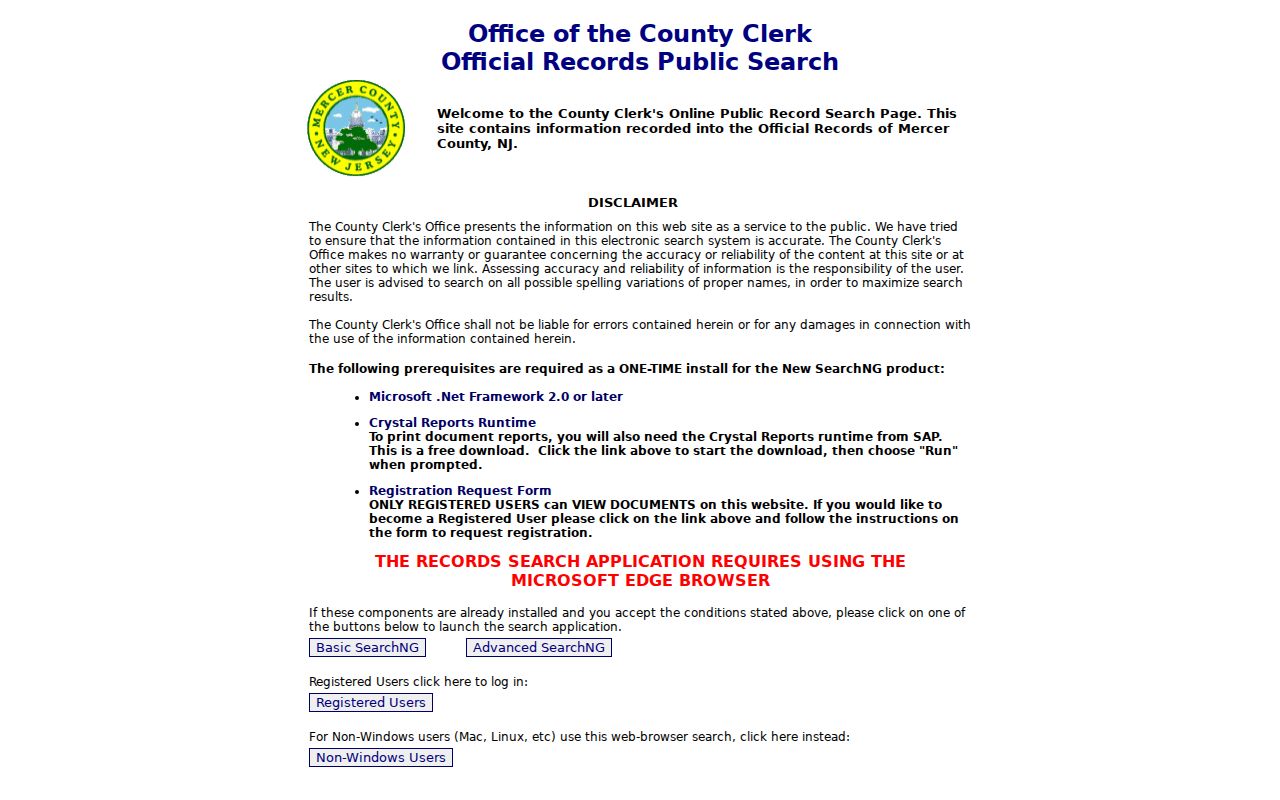
The search view is the entry point for a transaction trail. For each candidate deed, copy the instrument number, recording date, book and page, consideration, legal description, grantor, grantee, and linked documents. Those details make it possible to distinguish two similar names and return to the same record later.
- Use the current parcel or map result to record Ewing, block, lot, and legal-description clues.
- Locate the purchase deed or candidate current transfer in Mercer Official Records and identify the grantee, the buyer at that transfer.
- Read the grantor, the seller or prior owner at that transfer, then search that person as a grantee in an older deed.
- Repeat one transaction at a time, keeping a table with date, instrument, grantor, grantee, source, and confidence.
- When the online trail ends, move to the Records Room and deed books instead of assuming the chain is complete.
- Grantor and grantee
- The grantor transfers an interest in the property. The grantee receives it in the recorded transaction.
- Chain of title
- A sequence of recorded transfers used to follow ownership backward. It does not by itself identify every household.
- Legal description
- The block, lot, subdivision, metes-and-bounds, or related land description that links older records when a street address changes.
Ewing Township Past Residents Before 1997
Mercer's online McPress material reaches approximately back to 1997, according to the county's deed-search guide. The Clerk holds land documents from county incorporation in 1838, but that holding date is not a promise that all older images are in the online index. Once the chain reaches the online boundary, use the Records Room at the Old Court House Annex, where public inspection is available Monday through Friday from 8:30 a.m. to 4:30 p.m.
Staff can help a researcher become familiar with the computer index and recording system, but the Clerk does not perform a title search. Paper maps cover Mercer municipalities and subdivisions. For older deed support, the New Jersey State Archives genealogical collections describe county deed microfilm to 1900 and digitization or finding-aid routes. Confirm current access and copy procedures with the custodian.
Note: The online cutoff is an access boundary, not proof that pre-1997 ownership records are absent.
Ewing Township Past Residents Map Clues
Maps are often the bridge when an old directory number will not line up with a present address. Trentoniana's maps, atlases, and directories resources describe Sanborn sheets with building outline, size, shape, material, windows, doors, street names, sidewalks, property boundaries, use, and current or previous house and block numbers. The 1927 Library of Congress volume includes part of Ewing, and the library lists a 1935 Mercer property atlas and a 1936 Trenton-Princeton platbook.
The Trenton Historical Society's 1900 directory index is the source of this Ewing Township historical-address image.
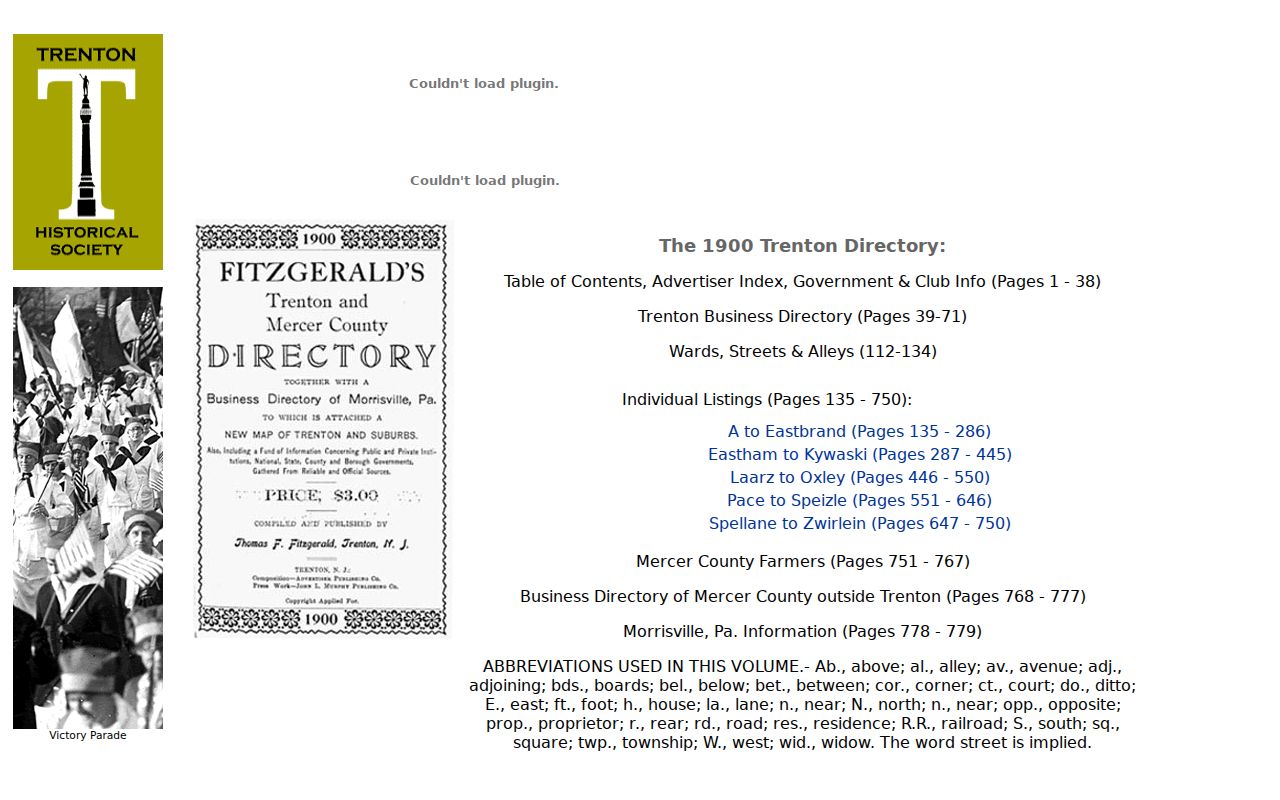
Use a map number or prior street form to guide a directory search, then keep the map date beside the listing date. The research did not verify a year-specific Ewing renumbering or renaming project. Sanborn previous-number fields and deed legal descriptions are the supported bridge when a number looks different.
Ewing Township Past Residents in Directories
Directories supply the household layer that deeds cannot. Trentoniana holds city directories from 1845 through 1971, and the Trenton Historical Society provides searchable OCR for 1844, 1859, partial 1877, 1881, 1882, 1900, and 1920. The Society's paid directory lookup is $10 per name per ten-year period. Use it for a bounded question, such as whether a surname appears at a known address in a certain decade.
Regional titles matter. Polk's 1948-65 Trenton City volumes include parts of Ewing, and the 1966 Polk Trenton Suburban title explicitly includes Ewingville, West Trenton, and parts of Ewing. A street-order section in a regional or telephone directory can act as a criss-cross aid, but no separately titled Ewing reverse-directory run was verified. The collections themselves are described in the Ewing Township city directory reference.
Read a listing as a dated occupancy lead. Record the person, street number, street name, directory year, page, occupation or business clue, and indicators such as h for house or bds for boards. An owner can live elsewhere, and an occupant may not be the deed holder. That difference is central when tracing past residents.
Ewing Township Past Residents Census Pairing
Pair a directory run with the census year around it. Trentoniana lists federal census microfilm for New Jersey for 1830-60, 1870, 1880, 1900, and 1920, plus Trenton state census microfilm for 1895, 1905, and 1915. Federal census records follow a 72-year public-release rule. A directory may reflect a different canvass date than the census, so a person can plausibly appear at different addresses in the same calendar year.
- Choose the directory listing closest to the period in question and transcribe its address and page.
- Check the matching or closest available census for household composition, age, and residence at enumeration.
- Compare the next directory year for a move, a changed street form, a boarding notation, or an absence.
- Use the 1935 atlas, 1936 platbook, or 1927 Sanborn sheet when the address does not translate cleanly.
- Return to the deed chain only for the ownership interval, not to fill missing household members.
This flow is useful for family history and a home's past because it separates ownership continuity from occupancy evidence. It also preserves uncertainty when the address, street label, or directory coverage changes.
Ewing Township Past Residents Place Names
Ewing Township was established in 1834, and Mercer County formed in 1838. Older records can use Trenton Township, Hunterdon County, Ewingville, West Trenton, canal-era landmarks, or nearby township labels. Those name shifts are a local research feature, not a mistake in every result. Search the historical term as printed, then test the connection with the directory title, map context, and legal description.
The documented difference between the post-1997 online index, older deed books, redacted public parcel data, and account-gated municipal SDL material is also part of the address trail. A gap in one channel can direct the next request, but it cannot be filled with an inferred person or address.
Ewing Township Past Residents Trail Endpoints
Obituaries and probate can close a historical trail, but each has a limited role. An obituary may provide a former address, relatives, or funeral information. A probate file can connect heirs, executors, and later mailing details. Neither source alone proves that a person occupied the Ewing property on the deed date. Use the date and address connection to decide whether a directory, newspaper, or deed search is the next check.
The Historical Society offers obituary copies for $8 when supplied a complete date, as well as yearbook and general research services. It says it does not conduct census or tax-record research. For a deceased former resident, that boundary is useful: ask the Society for the item in its holdings, then use the Clerk or State Archives for the appropriate legal record.
Ewing Township Past Residents Research Limits
Past-resident research is strongest when it remains a careful house-history record. A parcel can lack a public owner name, a deed can name an owner without confirming occupancy, and a directory can show an occupant without proving ownership. Daniel's Law and the New Jersey Address Confidentiality Program can limit public address disclosure, and other records may be sealed or redacted. Treat a missing result as a missing result, not a conclusion about a person.
Lawful use. Use Ewing Township address history for family history, estate matters, personal safety, or understanding a property's past. Do not use records to stalk, harass, or harm a living person; New Jersey law includes stalking and harassment restrictions.